
Multitasking Is a Lie, And It Was Burning Me Out
The Internal Rules That Were Running Me
When I left my full-time job to build Mentally Fit With Ellin, I genuinely thought I was ready. I’ve always been ambitious, disciplined, efficient with my time, and extremely organized. I’ve been the person who can juggle ten billion things and somehow make it look effortless.
Multitasking felt productive. It felt responsible.
I would answer emails between clients, plan content while walking through New York City almost tripping over myself, review billing while on the phone, prep for meetings while cooking and eating lunch.
I told myself this was drive. This was ambition.
But what it really was… was scattered. Chaotic. Anxious. Completely all over the place.
Suddenly, I wasn’t just doing the work I loved. I was doing everything at once. Every decision ran through me and felt heavy and urgent. Every detail mattered. Every unfinished task felt like proof that I was behind, and I took it personally.
My days were full. Completely full.
Back-to-back meetings. Texts I felt obligated to answer. Emails sitting in my inbox. Posts in drafts. Notes to myself about things I “should” get done.
And underneath it all was something heavier.
So many internal rules.
I should respond faster.
I should be more efficient.
I should be further along.
I should do it all.
I should be able to handle this.
Even when I “finished” work, my mind didn’t stop. It just moved to the next tab. Okay, what’s next?
By the end of the day, I felt drained and strangely unproductive. I had moved all day, but nothing felt complete.
That’s the trap.
When you’re wired to achieve, to perform, to hold it all together, multitasking feels like control. It feels like staying ahead. It feels impressive. It feels responsible.
But it’s a slow leak of mental energy. And it’s the kind of leak that quietly leads to burnout and mistakes.
Your brain doesn’t actually multitask. It switches back and forth, and every switch drains you. You miss details. You lose focus. You skim instead of thinking. You react instead of responding. You stop choosing how you want to show up and start responding to whatever is loudest.
When I read The One Thing, one question stopped me: What’s the one thing that, if done, makes everything else easier or unnecessary?
It forced me to confront something uncomfortable.
The real issue wasn’t my calendar. It was my discomfort with slowing down. It was the emotional relationship I had with doing one thing at a time. With choosing one thing. With letting something or someone else wait.
Because doing one thing well requires boundaries. It requires tolerating the discomfort of not answering that text yet. Not checking that email. Not jumping ahead to the next thing.
If I’m being honest, I don’t like to wait. I want success now. I want growth now. I want the results without having to choose what’s most important in this moment and commit to the process.
I want everything now. Anyone else?
When you’re ambitious, you’re ambitious about what you want now. And choosing one thing can feel like you’re falling behind somewhere else.
I know I’m not the only one who feels this way.
The Illusion of Multitasking
Once I started noticing my own patterns, I began seeing it everywhere.
Have you ever been in a conversation where someone says they’re listening, but you can tell they’re not? They’re scrolling through their phone, answering a text, glancing at an email. Or a parent “playing” with their kids while notifications keep pulling them away. Or someone at the gym, half in their workout, half on Instagram between sets.
Now, let me ask you something gently. When was the last time you did that?
We tell ourselves we’re maximizing time by multitasking. That we’re being efficient. That we’re staying on top of things.
But the reality is the opposite.
We’re not multitasking. We’re dividing our attention. And every time we switch focus, we lose a little clarity, a little energy, a little intention. Progress slows down. Presence disappears.
It’s distraction dressed up as productivity.
I hear people say all the time, “I don’t have time.”
But most of the time, it isn’t about hours in the day. It’s about choice. It’s about where your attention goes and what you decide deserves your energy.
That’s not a time problem. It’s a perception problem.
The shift begins when you stop blaming time and start owning where your time goes.
What Is Time Blocking?
I love time blocking. I use it every single day.
If you looked at my calendar, you’d see blocks of color everywhere. Specific tasks. Specific focus. “Website edits.” “Newsletter.” “Social media.” “Gym.” Dinner plans. Walks with friends. Even white space.
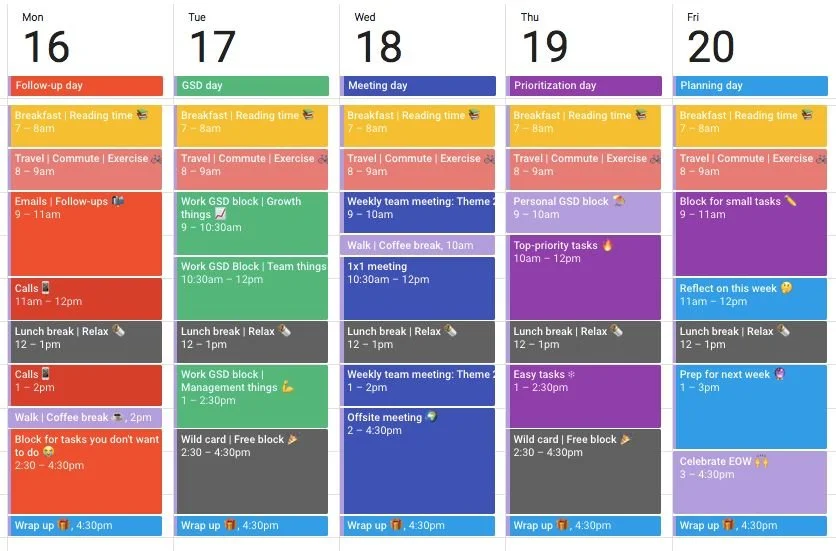
Here’s an example of what time blocking can look like. Not my actual calendar, just a visual to show how giving your priorities a home creates clarity.
At first, it might sound rigid. But for me, time blocking became freeing. It gave me permission to focus on one thing at a time without guilt.
Time blocking is simple. You assign specific blocks of time to specific priorities so you can focus on one thing at a time. Instead of reacting all day, you decide in advance what deserves your attention.
When I first started doing this, it was about clarity. I needed to see my time so I could understand what I was actually doing and where it was going.
Once I understood it, I didn’t need to be so rigid. I just needed to be intentional.
Time blocking helped me focus on one thing at a time and be honest about what season I’m in.
In the summer, I might prioritize social networking and events. In the winter, I focus more on building and behind-the-scenes business development.
For you, it might look like blocking “play with kids,” “meal prep,” “strategy calls,” or “gym.”
Each priority gets its own space. Its own container.
This isn’t about micromanaging your life. It’s about removing the mental clutter of deciding what to do next. When everything has a place, the negotiation stops. You just follow the plan.
This is exactly what I help my clients do.
We don’t just talk about goals. We look at how they’re structuring their days. We identify where their attention is leaking. We clarify what truly matters. Then we build a system that supports their ambition instead of sabotaging it.
If there’s one thing I’ve learned, it’s this: If you don’t control your schedule, it will control you.
7 Ways to Start Winning Your Day
Figure Out When You’re Most Productive
Notice when your energy is highest. Use that time for deep, focused work. Save lighter tasks for when your energy dips.List Your Priorities
Write down everything that matters. Not just work. Life. Relationships. Health. The goal is alignment, not just output.Block Your Calendar
Assign time slots to your priorities. Use Google Calendar, iCal, or even paper. Color-code it if that helps. Give your day structure.Set Boundaries
When you’re in a time block, commit fully. Silence notifications. Communicate availability. Protect your focus.Brain Dump for Clarity
If something pops into your head, write it down instead of switching tasks. This protects your momentum.Take Recharge Breaks
After a focused block, step away. Move your body. Reset. Your brain needs recovery to perform well.Review and Adjust
At the end of the day, reflect. What worked? What didn’t? Adjust. This is a practice, not perfection.
This week, try it.
Pick one day. Block your priorities. Protect one focused window. Notice what comes up when you choose one thing and let the rest wait.
And if something shifts for you, I’d genuinely love to hear. What felt easier? What felt hard? What surprised you?
This work isn’t about perfection. It’s about awareness.
Be like a postage stamp. Stick to one thing until you get there.
Let me know what you discover.
Let’s Keep Growing: What’s Next For You
Thank you for being here. Really. Every time you open one of these emails, it means something and I don’t take that lightly.
If this sparked something for you, I’d love to hear it. Just hit reply or email me at ellin@mentallyfitwithellin.com. And if you enjoyed this read, the best compliment you could give is to share it with one person or restack it.
If you’re new here or my thoughts from this week really resonated with you, I’d love to talk more. Community is everything to me, and my 10-minute community chats throughout the week are something I always look forward to. Here’s the link to set one up!

Mentally Fit With Ellin is a community of thousands like-minded people committed to growth, resilience, and mental performance. As a licensed therapist and performance coach, Ellin Gurvitch, started this to give everyone access to the tools needed to develop sustainable habits and enhance mental well-being. For more Mentally Fit With Ellin, make sure you’re subscribed so that each week you’ll receive practical mindset tools and performance strategies delivered to your inbox.
